Less noise, faster to the part
A decluttered header and homepage, best sellers right under the banner, fewer trust badges fighting for attention, and a faster store with page caching.
 Book a call
Results / My Inboard Marine
How My Inboard Marine grew by building a store for buyers, not for looks.
February to September 2026 against the same months of 2025. Visitors and orders from Shopify with bots removed; revenue from Google Analytics.
Donny, owner of My Inboard Marine
My Inboard Marine sells inboard engine parts to boat owners and the mechanics who keep them running: Crusader, PCM, Indmar, Faria, NGK, Sierra and more. It's a real business with a small team. Donny runs it and places every order with his suppliers, and the warehouse team picks, packs and ships.
When Donny and I started, the store was getting plenty of visitors, but only about 2 in every 100 of them bought anything. Paid traffic cost more every year. And behind the store, the business ran on supplier price files, spreadsheets and a lot of checking by hand.
So the goal was never a prettier store. It was growth: sell more to the people who were already visiting, and take the manual work off Donny's plate so he could run the business instead of babysitting it.
The goal was more sales from less traffic. Not the most beautiful store in the marine world.
Every single month since launch, a bigger share of visitors bought. Traffic fell by about a fifth, and orders still rose by more than a quarter. That's what happens when the store does its job.
Phone buying rate, up 70%. Phone orders up 42% on fewer phone visits.
Orders from returning customers. People came back and bought again.
From AI assistants like ChatGPT, a channel that didn't exist for the store in 2025.
Every change had one test: does it help a parts buyer find the right part and check out? Anything that didn't pass came off.
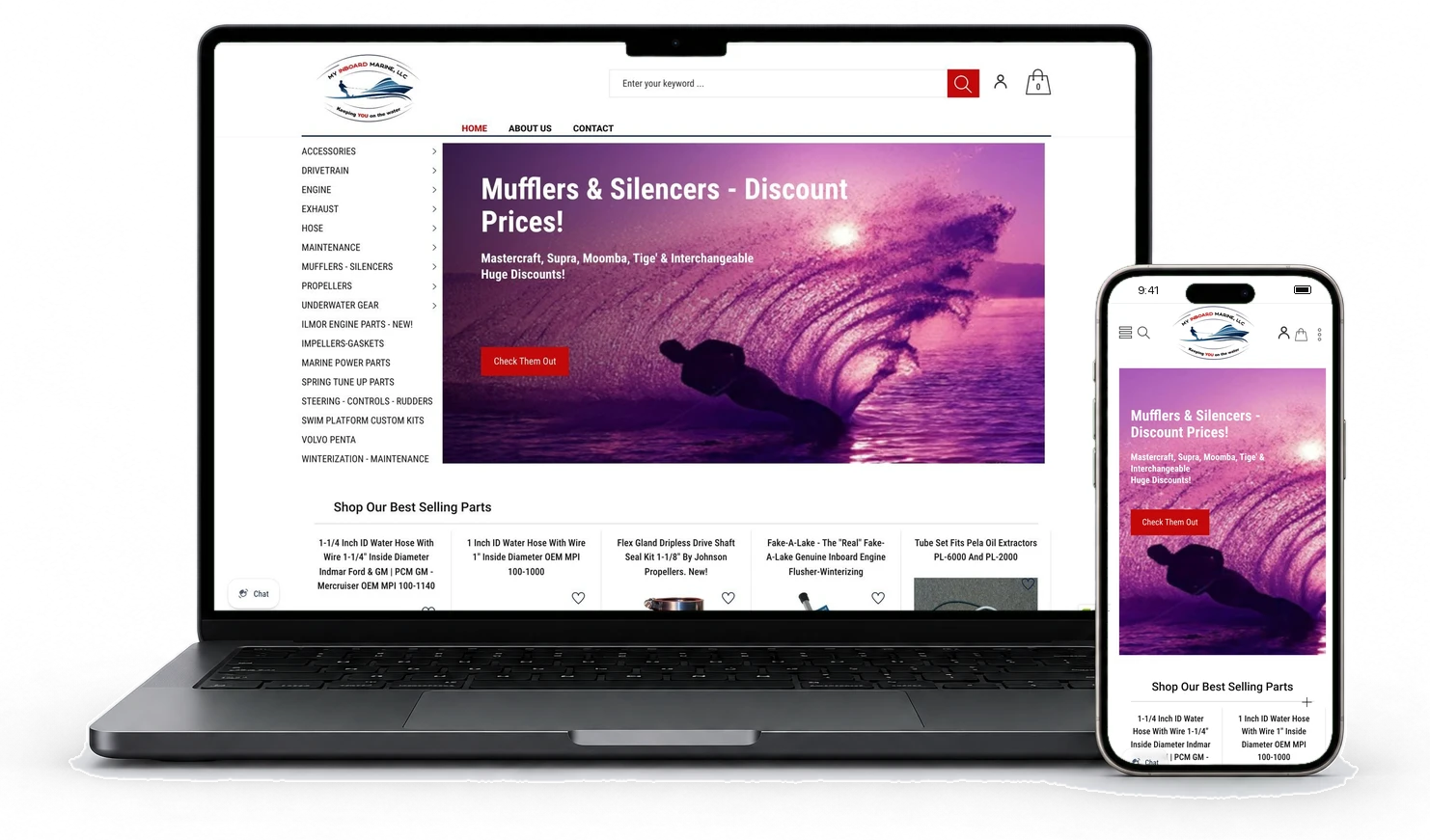
A decluttered header and homepage, best sellers right under the banner, fewer trust badges fighting for attention, and a faster store with page caching.
A product page laid out for buying, with an add to cart button that stays on screen on phones, and a simpler cart.
The sitewide strike-through "sale" prices came off. Parts buyers know what parts cost, and fake discounts cost trust.
The shipping protection add-on became a clear choice, with a full-size "checkout without coverage" button on the cart and the mini cart, so nobody abandons over it.
International shipping copy that confused buyers came off every product page.
Selling through the Shop app and AI assistants like ChatGPT was switched on. AI assistants alone brought 40 orders from February to September.
A new store is the easy part. The growth came from fixing how the business runs behind it, with tools built for Donny's exact problems.
Donny's biggest supplier sends a price and inventory file every week, and selling below their minimum advertised price (MAP) can get him cut off. The app compares the file against his whole Shopify catalog and sorts it: below MAP, losing money, cost up, cost down, no match. He ticks the rows and pushes the fixes straight to Shopify.
Some parts are bought singly and sold in packs, others are bought by the roll and sold by the foot. The app knows which way the math goes. It caught a pack of spark plugs about to go live at $1.50 against a real cost of $96.16.
Projects what he'll sell in the next two weeks from the same weeks last year plus his growth rate, so Donny orders what he needs before he runs out, not after.
Printed pick tickets for the warehouse, built around how orders actually get picked and packed, including what the customer paid.
A year-to-date revenue growth report pinned in Shopify, and a "have I ever sold it" report that follows a product even when its SKU changes.
An AI that reads about 200 supplier PDFs and answers year, make and model questions like "which impeller fits a 1985 351 PCM". It already gets that one right.
Most of the weekly work never shows on the storefront. It's the warehouse, the catalog and the decisions that keep a parts business profitable.
A full report of every product that has never sold, checked against 26,487 orders going back to 2018, so Donny could clear dead stock without deleting anything that still sells.
A hidden clearance collection priced at cost with the discount behind a checkout code, which clears old stock and keeps him inside his suppliers' pricing rules.
Every product sorted into 12 clear categories with 12 filters, like engine platform, displacement and shaft bore size. 5,429 values loaded onto 2,470 products with zero errors, ready for the next version of the store.
A standing call every Friday. Donny brings what's in his way, and it gets fixed, built or planned. He learned to make many of the changes himself.
“I'm not kidding when I said you saved the company. I'm not kidding. I'm serious.”
Donny, owner of My Inboard Marine, August 2026
“The import of the price file from [the supplier] today was smooth as silk. LOVE IT MAN!!”
Donny, by email, September 2026
I'll look at your store and your business, and tell you where I'd start.